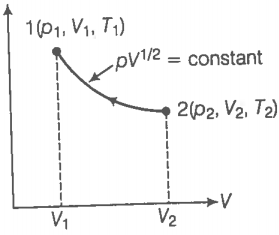
Consider a p-V diagram in which the path followed by one mole of a perfect gas in a cylindrical container is shown in the figure.

(a) Find the work done when the gas is taken from state 1 to state 2.

(b) What is the ratio of temperatures T1/T2 if V2=2V1?
(c) Given the internal energy for one mole of gas at temperature T is (3/2)RT, find the heat supplied to the gas when it is taken from state 1 to 2 with V2=2V1.

Hint: The process is an adiabatic process.
Let, pV1/2=Constant=K, p=KV
Step 1: Find the work done by the gas.
(a) Work done for the process 1 to 2,
                              W=∫V1V2pdV=K∫V1V2dVV=KV1/2V1V2=2K(V2-V1)
=2p1V11/2(V2-V1)=2p2V21/2(V2-V1)
Step 2: Use the ideal gas equation.
(b) From the ideal gas equation,
 pV=nRT⇒T=pVnR=pVVnR
⇒T=KVnR(As,pV=K)
Hence,                       T1=KV1nR&T2=KV2nR
⇒T1T2=KV1nRKV2nR=V1V2=V12V1=12(∵V2=2V1)
(c) Step 3: Use the first law of thermodynamics.
Given, the internal energy of the gas, U=32RT
∆U=U2-U1=32R(T2-T1)
=32RT1(2-1)              [∵T2=2T1]
∆W=2p1V11/2(V2-V1)
=2p1V11/2(2×V1-V1)
=2p1V1(2-1)=2RT1(2-1)
∵∆Q=∆U+∆W=32RT1(2-1)+2RT1(2-1)
=(2-1)RT1(2+3/2)
=72RT1(2-1)
This is the amount of heat supplied.